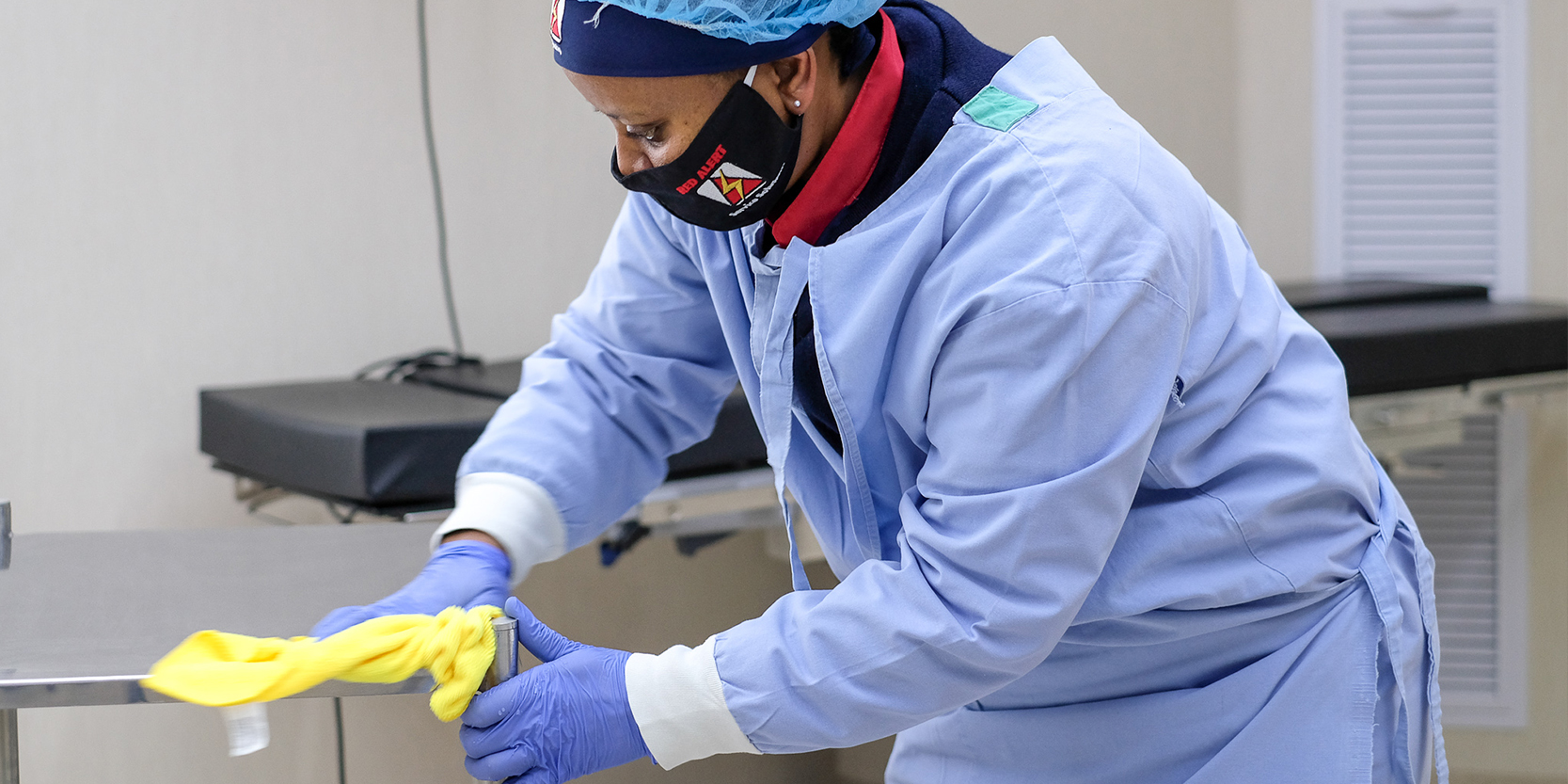
What your workspace is doing to your people’s minds – whether you realise it or not
We tend to think of workplace hygiene in physical terms. Germs. Surfaces. The spread of illness. The compliance box that needs to be ticked before the auditor arrives. These things matter – but the psychology behind clean has a far more interesting impact than most businesses have stopped to consider.
Because what a clean environment does to the human mind goes considerably further than the absence of bacteria. And the businesses that understand this are managing something most of their competitors have never thought to measure.
What the research actually says
Environmental psychology has been building a consistent body of evidence for decades, and the findings are striking.
People in clean, well-ordered environments make better decisions. They are more likely to choose ethically, more likely to follow through on commitments, and more likely to extend trust to the people around them. A landmark study by researchers at the University of Minnesota found that people in tidy environments were significantly more likely to donate to charity and choose healthy food options than those in cluttered, disordered ones – even when the researchers controlled for every other variable.
The implication is uncomfortable but important: the state of your workplace is not just a reflection of your standards. It is actively shaping the behaviour and decision-making of every person who spends time in it.
Disorder, by contrast, has measurable costs. Studies on cognitive load – the mental effort required to process an environment – consistently show that cluttered, poorly maintained spaces consume mental bandwidth that would otherwise be available for focus, creativity, and problem-solving. Your brain is remarkably good at filtering signal from noise, but it is always working. An environment that demands constant low-level processing leaves less capacity for the work that actually matters.
The stress connection
There is a direct physiological link between environmental disorder and stress that most businesses have never considered in the context of their cleaning and hygiene programme.
Cortisol – the body’s primary stress hormone – is elevated by visual and sensory disorder. Not dramatically, not in a way that feels acute, but consistently and cumulatively. A workspace that is habitually cluttered, poorly maintained, or carries the ambient signals of neglect – a sticky surface, a malfunctioning fixture, an unpleasant odour – keeps the stress response at a slightly elevated baseline throughout the working day.
Over time, that baseline matters. Elevated cortisol suppresses immune function, disrupts sleep, impairs memory consolidation, and reduces the capacity for the kind of complex, patient thinking that knowledge work demands. The link between a poorly maintained workspace and increased sick days, reduced productivity, and higher staff turnover is not simply about pathogen transmission. It runs through the nervous system as much as the ventilation system.
What clean does to culture
Perhaps the most significant and least discussed effect of a well-maintained workspace is what it communicates to the people who work in it.
Environments send messages. A workspace that is consistently clean, well-stocked, and properly maintained tells the people using it something important: that someone is paying attention. That standards are taken seriously. That the people here are worth the effort of doing things properly.
This is not a trivial signal. Research on organisational behaviour consistently shows that employees take their cues about acceptable standards from the environment they are given to work in. A business that maintains high standards in its physical environment tends to find those standards reflected in its people’s work. The reverse is equally true – and equally consequential.
There is a concept in criminology known as the broken windows theory: the idea that visible signs of disorder invite further disorder. A broken window that goes unrepaired signals that no one is watching, that standards have slipped, that the rules are loosely enforced. The same principle operates in a workplace. A soap dispenser that is consistently empty, a washroom that is cleaned inconsistently, a bin that regularly overflows – these are broken windows. They do not just inconvenience the people who notice them. They quietly communicate something about what this organisation values, and what it does not.
The productivity question
If all of this sounds abstract, consider it through the lens of productivity – a metric every business understands.
The average knowledge worker loses a meaningful portion of their productive capacity to environmental distraction, cognitive load, and low-grade stress. Studies vary in their specific findings, but the consistent direction of the evidence is clear: people work better, think more clearly, and make fewer errors in clean, ordered, well-maintained environments than in neglected ones.
For a business employing fifty people, the cumulative productivity cost of a poorly maintained workspace is not a rounding error. It is a measurable drag on output that shows up in every quarterly result – invisibly, attributed to other causes, never traced back to the state of the office carpet or the washroom that nobody wanted to raise in a management meeting.
Why hygiene is a leadership decision
Most businesses treat hygiene and cleaning as an operational matter – delegated to facilities management, budgeted as modestly as possible, reviewed only when something goes visibly wrong.
The research suggests it deserves to be treated as a leadership decision.
The environment a business creates for its people is a statement of values. It communicates – more loudly than any culture document or values statement – what the organisation actually believes about the people who work there and the standards it holds itself to. A business that invests in a genuinely clean, well-maintained workspace is not spending money on aesthetics. It is investing in the cognitive performance, emotional wellbeing, and cultural alignment of every person who walks through the door.
That is a different conversation entirely from the one most hygiene budgets are having. And it is one that the most forward-thinking businesses are already starting to have.
The next time you walk through your workplace, try to see it the way a visitor would. Not the visitor you are trying to impress – the one who arrives unannounced, uses the washroom, notices the state of the common areas, and forms a quiet, lasting opinion about what kind of organisation this is.
What is your environment saying?
And more importantly – is it saying what you intend?
Red Alert’s professional hygiene division keeps workplaces functioning at the standard that people and businesses deserve – consistently, professionally, and with the attention to detail that makes the difference between a space that merely looks clean and one that genuinely is. Get in touch at redalert.co.za.